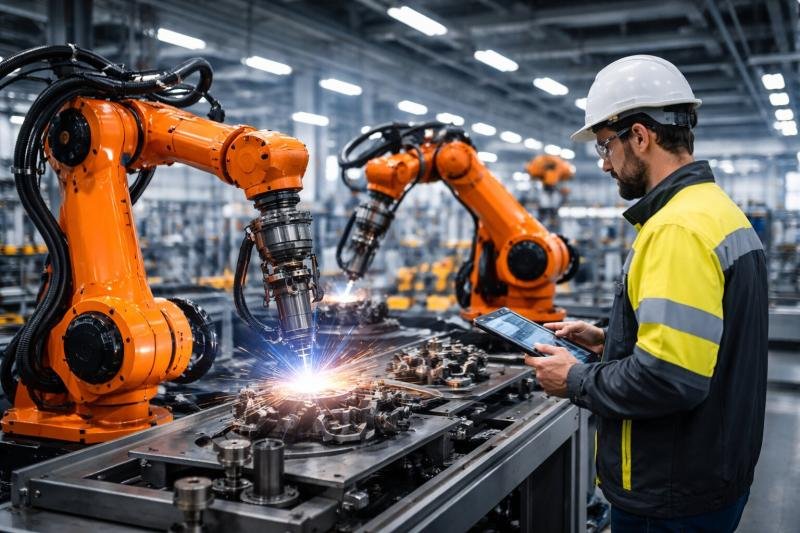

Industrial Robotics Market
The global Industrial Robotics Market reached US$20.50 billion in 2024 and is expected to reach US$42.99 billion by 2032, growing at a CAGR of 9.70% during the forecast period 2026 to 2033. The market is witnessing strong growth as industries increasingly adopt automation to enhance productivity, precision, and operational efficiency.
Market growth is driven by the rising demand for automation across manufacturing sectors such as automotive, electronics, and metal processing, along with increasing labor costs and the need for workplace safety. Industrial robots play a crucial role in streamlining production processes, improving product quality, and reducing human error. In addition, advancements in robotics technologies, including artificial intelligence, machine vision, and collaborative robots, are accelerating adoption across both large enterprises and small and medium-sized businesses. Growing investments in smart factories and Industry 4.0 initiatives, along with supportive government policies promoting industrial automation, are further fueling market expansion.
Download Sample PDF Of This Report (Get Higher Priority for Corporate Email ID):- https://www.datamintelligence.com/download-sample/industrial-robotics-market?sai-v
Key Developments
✅ February 2026: Across North America, Europe, and Asia Pacific, manufacturers accelerated the adoption of industrial robots integrated with AI and machine vision systems to enhance precision, reduce labor dependency, and improve production efficiency in automotive and electronics sectors.
✅ January 2026: Globally, increasing labor shortages and rising wage pressures drove industries such as automotive, metals, and food processing to expand investments in automation and collaborative robots for flexible manufacturing.
✅ December 2025: Leading companies such as ABB, Fanuc, KUKA, Yaskawa Electric, and Mitsubishi Electric expanded their industrial robotics portfolios, focusing on AI enabled robots, digital twins, and smart factory solutions.
✅ November 2025: Across Europe and North America, government initiatives supporting Industry 4.0 and smart manufacturing encouraged adoption of advanced robotics, particularly in small and medium enterprises.
✅ October 2025: Globally, companies intensified investments in next generation robotics technologies including autonomous mobile robots, cloud robotics, and edge computing to enhance operational efficiency and real time decision making.
✅ September 2025: Across key markets including China, Japan, South Korea, Germany, and the United States, strong growth in automotive electrification and electronics manufacturing significantly boosted demand for industrial robots.
Competitive Landscape and Industry Partnerships
The Industrial Robotics Market is characterized by the presence of leading global automation and robotics companies focused on enhancing manufacturing efficiency, precision, and flexibility across industries such as automotive, electronics, metals, food and beverages, and pharmaceuticals. Industrial robots play a crucial role in streamlining production processes, reducing operational costs, improving product quality, and addressing labor shortages. Increasing adoption of smart manufacturing, Industry 4.0 technologies, and automation across emerging economies is significantly driving market growth.
Leading companies operating in the market include Mitsubishi Electric, ABB, Fanuc, Yaskawa Electric, and Omron, among others. These companies are actively developing advanced robotic systems, controllers, and integrated automation solutions to cater to evolving industrial needs.
Market participants are investing heavily in innovations such as collaborative robots (cobots), artificial intelligence enabled robotics, machine vision systems, and digital twin technologies. These advancements are improving operational efficiency, enabling human robot collaboration, and supporting real time monitoring and predictive maintenance in manufacturing environments.
Strategic collaborations between robotics manufacturers, software providers, system integrators, and industrial enterprises are accelerating the deployment of automation solutions. Partnerships are also facilitating the integration of robotics with IoT platforms, cloud computing, and advanced analytics, enabling smarter and more connected production ecosystems.
As industries continue to embrace digital transformation and automation, companies operating in the industrial robotics market are expected to expand their global footprint, invest in next generation technologies, and deliver scalable, flexible, and cost effective robotic solutions to meet growing industrial demand.
Purchase Corporate License | Market Intelligence:https://www.datamintelligence.com/buy-now-page?report=industrial-robotics-market?sai-v
Market Drivers
– Rising adoption of automation across manufacturing industries such as automotive, electronics, and metal fabrication is significantly driving demand for industrial robots to improve productivity and reduce operational costs.
– Increasing labor shortages and rising labor costs in developed and emerging economies are accelerating the shift toward robotic automation in production facilities.
– Growing demand for precision, efficiency, and high-quality output in mass production environments is boosting the deployment of advanced robotic systems.
– Rapid advancements in technologies such as artificial intelligence, machine learning, and computer vision are enhancing robot capabilities and expanding their application scope.
– Increasing focus on workplace safety and reduction of human intervention in hazardous environments is driving the adoption of industrial robots.
– Expansion of e-commerce and logistics sectors is fueling demand for robotics in warehousing, packaging, and material handling operations.
– Government initiatives supporting smart manufacturing and Industry 4.0 adoption are encouraging investments in industrial automation globally.
Industry Developments
– Shift from traditional industrial robots to collaborative robots (cobots) that can safely work alongside humans in shared environments.
– Increasing integration of AI-powered vision systems and real-time analytics to improve robotic accuracy, flexibility, and decision-making.
– Growing adoption of mobile robots and autonomous guided vehicles (AGVs) in warehouses and manufacturing plants.
– Strategic partnerships and acquisitions among key players to enhance product portfolios and expand global presence.
– Rising investment in robotics-as-a-service (RaaS) models, enabling small and medium enterprises to adopt automation with lower upfront costs.
– Development of modular and flexible robotic systems to support customized and small-batch production.
– Increasing use of digital twins and simulation technologies for optimizing robot performance and reducing downtime.
Regional Insights
Asia Pacific 50% share: Dominates the market driven by strong manufacturing base, rapid industrialization, and high adoption of robotics in countries such as China, Japan, South Korea, and India.
North America 22% share: Growth supported by advanced manufacturing infrastructure, increasing adoption of automation, and strong presence of leading robotics companies.
Europe 18% share: Driven by Industry 4.0 initiatives, high focus on precision engineering, and strong automotive and industrial sectors.
Latin America 6% share: Emerging growth due to increasing industrial automation and investments in manufacturing modernization.
Middle East & Africa 4% share: Gradual adoption supported by industrial diversification and growing investments in automation technologies.
Speak to Our Analyst and Get Customization in the report as per your requirements:https://www.datamintelligence.com/customize/industrial-robotics-market?sai-v
Key Segments
By Type
Articulated robots represent the dominant segment in the industrial robotics market, driven by their high flexibility, wide range of motion, and ability to perform complex tasks such as welding, painting, assembly, and material handling. Cartesian robots also represent a significant segment, known for their precision, rigidity, and suitability for linear movements in applications such as CNC machining and pick-and-place operations. SCARA robots represent an important segment, widely used for high-speed assembly and packaging tasks due to their selective compliance and efficiency. Delta robots represent a fast-growing segment, particularly in the food and electronics industries, offering high-speed picking and sorting capabilities. Cylindrical robots represent a niche segment, utilized in simple handling and assembly operations with cylindrical work envelopes. Polar robots represent one of the earliest robot types, used in specialized applications requiring spherical work envelopes, though their adoption is relatively limited compared to modern robot designs.
By Payload
Robots with payload capacity of 16-60 kg represent the dominant segment, as they are widely used across automotive, electronics, and general manufacturing applications for handling medium-weight components. The 60-225 kg segment also represents a significant share, particularly in automotive and heavy industries for tasks such as spot welding and material handling of large parts. The 225 kg segment represents a specialized segment, primarily used in heavy industries such as metal processing and large component handling, where high payload capacity is essential.
By End-User Industry
The automotive industry represents the largest segment in the industrial robotics market, driven by extensive use of robots in welding, painting, assembly, and material handling processes. Electricals and electronics represent a rapidly growing segment, fueled by rising demand for precision manufacturing and miniaturized components. The metal industry also represents a significant segment, utilizing robots for cutting, welding, and heavy material handling operations. The chemical, rubber, and plastics industry represents an important segment, where robots are used for molding, packaging, and hazardous material handling. The food and beverages industry represents a growing segment, driven by increasing automation in packaging, sorting, and quality control processes to ensure hygiene and efficiency. Other industries include pharmaceuticals, logistics, and general manufacturing, where robotics adoption is steadily increasing to improve productivity and operational efficiency.
Unlock 360° Market Intelligence with DataM Subscription Services: https://www.datamintelligence.com/reports-subscription
Power your decisions with real-time competitor tracking, strategic forecasts, and global investment insights all in one place.
✅ Competitive Landscape
✅ Sustainability Impact Analysis
✅ KOL / Stakeholder Insights
✅ Unmet Needs & Positioning, Pricing & Market Access Snapshots
✅ Market Volatility & Emerging Risks Analysis
✅ Quarterly Industry Report Updated
✅ Live Market & Pricing Trends
✅ Import-Export Data Monitoring
Have a look at our Subscription Dashboard: https://www.youtube.com/watch?v=x5oEiqEqTWg
Contact Us –
Company Name: DataM Intelligence
Contact Person: Sai Kiran
Email: Sai.k@datamintelligence.com
Phone: +1 877 441 4866
Website: https://www.datamintelligence.com
About Us –
DataM Intelligence is a market research and consulting firm that provides end-to-end business solutions to organizations from research to consulting. We, at DataM Intelligence, leverage our top trademark trends, insights, and developments to emancipate swift and astute solutions to clients like you. We encompass a multitude of syndicate reports and customized reports with a robust methodology, ensuring that our clients receive tailored insights that address their specific business challenges and objectives.
Our research database features countless statistics and in-depth analyses across a wide range of 6300+ reports in 40+ domains, creating business solutions for more than 200+ companies across 50+ countries, catering to the key business research needs that influence the growth trajectory of our vast clientele.
This release was published on openPR.